A healthy intestinal flora promotes digestion and stimulates defenses. Discover how to enrich your recipes with foods that maintain their balance.
All fresh and natural foods offer their nutrients and vital energy, but only a few provide a benefit beyond their nutritional qualities: among them are probiotic foods, rich in microorganisms that contribute to improving and increasing healthy intestinal flora and, therefore, to enhance the body’s defensive capacity.
The digestive system is a microcosm where thousands of beneficial organisms coexist with others that are not. Health depends in part on the balance in favor of the former. Probiotics, usually lactobacilli and bifidobacteria, add to the ranks of the “good” ones and hinder the presence of pathogenic microorganisms.
But they don’t act alone. There are foods that favor their development. These are the “prebiotics”, whose effect lies in some of their indigestible compounds: short-chain carbohydrates such as oligosaccharides and inulin.
These activate the growth of beneficial endogenous bacteria, drag cholesterol and triglycerides, improve the assimilation of some nutrients, improve colitis and help prevent colon cancer.
This simplification reflects the need to consume foods of one type and another that favor the richness and quality of the intestinal flora.
And it is that a diet scarce in this type of food can affect the balance of the flora and create a favorable terrain for infections and digestive disorders. Regular consumption of highly refined foods, stress and excessive use of antibiotics can also deteriorate it.
MORE PROBIOTICS WITHOUT SUPPLEMENTS: NATURAL PROBIOTIC FOODS
Many times, advertising informs – or misinforms – about the need to include in the diet functional foods enriched with probiotics or prebiotics.
In some cases, when a very damaged or almost non-existent intestinal flora is detected, it is advisable to resort to supplements or functional foods, for example after a long course of antibiotics.
However, despite how comfortable it is to consume fortified foods, there are others that contain microorganisms or fibers beneficial to the flora naturally. In a healthy person, a natural diet rich in these foods should suffice.
FOODS THAT CONTAIN PROBIOTICS
Probiotics are mainly present in fermented foods such as unpasteurized yogurts, kefir, sauerkraut, bread made with mother yeast and soy derivatives such as miso or unpasteurized soy sauce itself.
Umeboshi plums, a popular Chinese delicatessen in Japan that can be found in dietetics and natural food stores, are also a good probiotic.
These foods are naturally rich in beneficial microorganisms for the balance of intestinal flora.
In yogurt, perhaps the easiest to incorporate daily into the diet, fermentation makes lactose digestible and makes calcium in milk more assimilable, in addition to activating the metabolism of other minerals, amino acids and vitamins.
Kefir, which can be prepared with milk, tea or water, provides a richer and more complex microbiological flora. It is usually made at home with nodules composed of bacilli and yeast, although it can also be bought made.
Miso and tempe, both derived from soy, are two great probiotics. Miso is a tasty condiment that is made by fermenting soybeans alone or accompanied by barley or rice. Tempe, a whitish, granulated cake rich in proteins and enzymes, is obtained from boiled soybeans inoculated with a mushroom.
The prebiotic substances that nourish all these microorganisms in the intestine are found mainly in plant foods and those richest in fiber. Wheat and its derivatives, garlic, asparagus, onions, leeks, beets and artichoke are an example.
Fermenting vegetables naturally with salt and water in the absence of air is another way to obtain probiotic microorganisms.
To prepare them at home:
- The chosen vegetables (cabbage, carrots, onion, leek, turnips or beetroot) are washed, chopped and placed in a clean glass jar.
- They are squeezed with a wooden mallet and, when you have half a full jar, add a teaspoon of coarse salt.
- It continues to be filled in the same way, another dose of salt is added and the holes are filled with mineral water.
- It is hermetically sealed and stored in a dark and warm place, on a plate in case it oozes, for 15 days.
- Once the jar is opened, it is kept in the fridge for a maximum of 15 more days.
COOKING WITH PROBIOTICS: WHAT DO YOU NEED TO KNOW?
The main rule for the use of probiotics in the kitchen is to moderate the cooking time and temperature, and enhance their daily and raw consumption. Discover how to use each of these foods in the kitchen.
- Yogurt. It should be consumed as fresh as possible. It is an excellent dessert, the base for many smoothies, a softener of creams and gazpachos, and a base of exquisite sauce.
- Kefir. With an acidic and somewhat gaseous taste, it is ideal as a drink, in a smoothie with fruits or nuts, as a salad sauce or as part of a cold soup.
- Fermented vegetables. They are used in salads and sauces, and with legumes or cereals. The sauerkraut, fermented cabbage typical of Alsace, stands out. It is excellent accompanied by kefir or yogurt; in salad with pineapple, raisins, apple and carrot; or as an accompaniment to vegetables, potatoes or meat.
- Mother yeast. A quality bread, made with whole wheat flours and fermented with mother yeast, is a good option to balance the bacterial flora.
- Miso. It is used to flavor broths, soups, stews or pâtés. It heats only slightly, because if it boils it loses properties. It is rich in salt: just one teaspoon per person.
- Tempe. This protein-rich soy derivative is not eaten raw: it is fried, roasted, grilled or stewed.
- Sprouts. The grains and seeds when germinating intensify their enzymatic activity and exert a certain probiotic effect. They should be consumed fresh and raw, in salads, fillings, pâtés and sauces.
- Soy sauce. As long as it is of quality, made by slow fermentation and unpasteurized, it is a good complement and dressing. It must be used at the end of cooking and in moderation, as it is salty.
- Umeboshi plums. They are sold in paste or whole and their flavor is strong, between sour and salty. To prepare digestion it is advisable to undo a small piece in the mouth before eating. They are also used to accompany cereals and vegetables, and as a dressing with oil or soy sauce.
6 RECIPES TO FILL YOUR BODY WITH PROBIOTICS
AVOCADO AND KEFIR GAZPACHO WITH HAZELNUT POWDER
Ingredients (for 4 people):
- 1 avocado to the point, peeled and chopped
- 150 ml kefir
- 100 ml orange juice
- 40 g roasted and ground hazelnuts
- 20 ml olive oil
- a pinch of salt
Preparation (10′ + 1h. rest):
- Pour the orange juice into the blender glass. Add the avocado and add the olive oil, salt and kefir.
- Blend until you get a homogeneous cream and, if it is very thick, rinse, with a little cold water or more orange juice. Let cool in the fridge.
- Distribute the cream in small cups. Peel the hazelnuts, grind finely and sprinkle on top.
Nutritional information:
- Calories: 255
- Carbohydrates: 6 g
- Protein: 4 g
- Fat: 24 g
- Cholesterol: 4 mg
SAUERKRAUT CRISPY ROLLS
Ingredients (for 4 people):
- 8 sheets of rice paper
- 150 g sauerkraut
- 1 carrot
- 18 whole prawns
- 2 red tomatoes
- 10 g butter
- 200 g green beans
- 1 lime
- 4 branches of parsley or cilantro
- A splash of cognac (optional)
- olive oil and salt
Preparation (15’+28′ cooking):
- Preheat the oven to 170º C. Wash the beans, cut them diagonally lengthwise and cook in boiling water with salt for six minutes. Drain and cool well. Peel the carrot and cut into long, thin strips.
- Peel the prawns and remove the heads. Sauté the remains of skin in a little olive oil, add two grated red tomatoes, let it fry and pour a splash of cognac if you want. Once the alcohol evaporates, pour a glass of water and let it boil. With the turmix crush the sofrito; Strain the juice obtained and rectify salt. Reheat it and add the butter.
- Chop the bodies of the prawns, drizzle with lime and mix them with the carrots, beans and chuchrut. Rectify salt and add parsley or coriander.
- On a clean cotton cloth spread the sheets of rice paper, moisten them slightly with a little water (with the help of a brush or fingertips) and arrange the vegetable mixture in the center. Fold each leaf into a package or roll them like cannelloni and brush them with olive oil.
- Place the rolls in the oven and cook until golden and crispy. Serve with the shrimp sauce.
BITTERSWEET TEMPE WITH RICE
Ingredients (for 4 people):
- 4 tempe bars (60 g each)
- 200 g basmati rice
- 4 pineapple slices in syrup
- 40 g raisins
- 6 dates
- 1 carrot
- 1 teaspoon umeboshi vinegar
- olive oil and salt
To cook the tempe and sauce:
- 3 tablespoons soy sauce
- 1 tablespoon honey
- 1 teaspoon ginger powder
- 200 ml vegetable broth
- 1 teaspoon cornstarch
- 1 teaspoon butter
Preparation (20’+27′ cooking):
- Mix the soy sauce with the honey, ginger and vegetable broth and cook the tempe within about twelve minutes. Once cooked, remove the tempe and let the broth reduce. When it thickens a little, lighten it with a teaspoon of cornstarch dissolved in cold water and add the butter.
- In a frying pan, heat a little oil and brown the tempe. Add the chopped pineapple, raisins, dates and carrot, let cook for a few minutes, add the vinegar and turn off the heat.
- Boil the rice in salted water for about 12-14 minutes, drain, drizzle with oil and serve with the tempe and sauce on top.
Nutritional information:
- Calories: 467
- Carbohydrates: 73 g
- Protein: 15 g
- Fat: 11 g
- Cholesterol: 6 mg
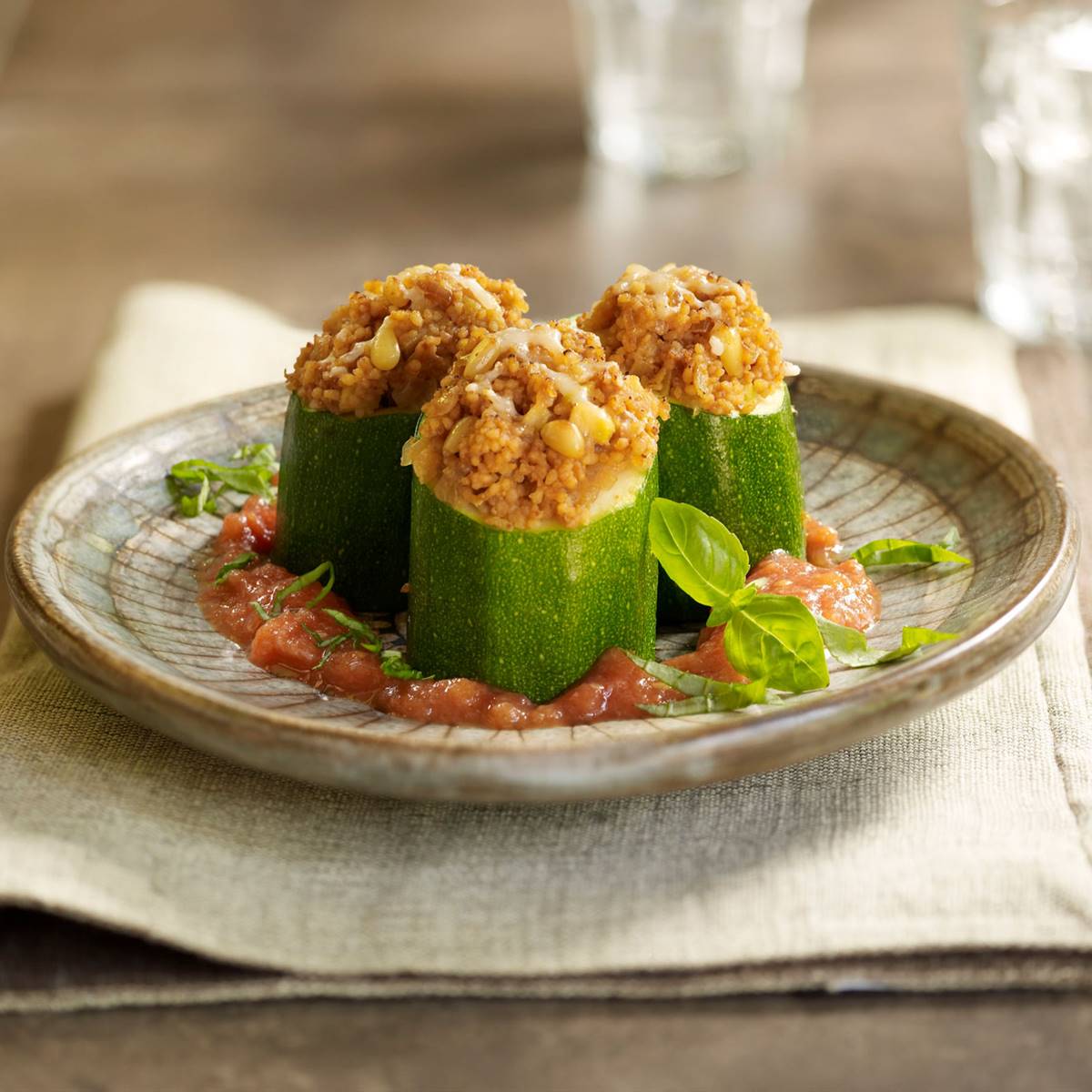
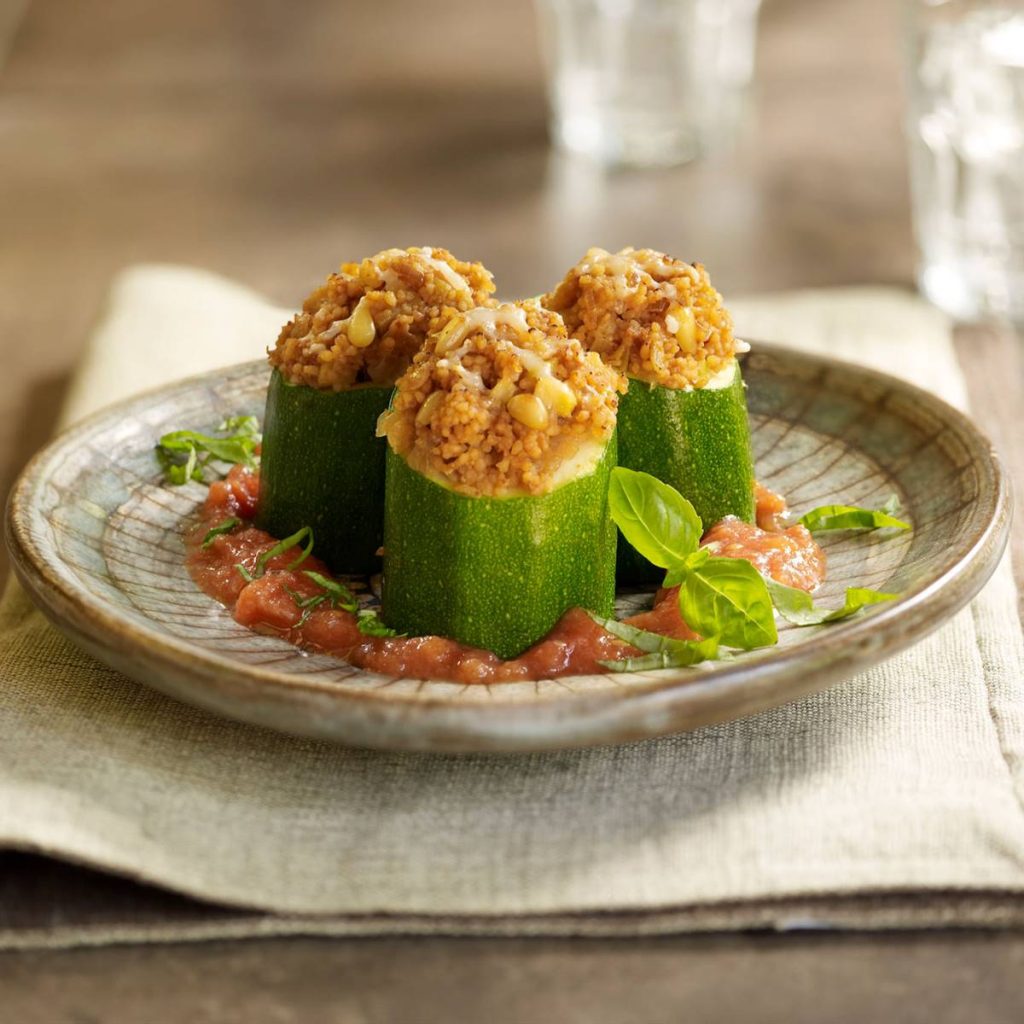
ZUCCHINI STUFFED WITH COUSCOUS WITH MISO
Ingredients (for 4 people):
- 3-4 medium zucchini
- 100 g cooked couscous
- 1 medium onion
- 30 g pine nuts
- 3 tablespoons miso
- 40 g grated Parmesan
- 3 tablespoons olive oil and salt
For the sauce:
- 4 red tomatoes
- a pinch of sugar
- 1 tablespoon miso
- 2 fresh basil sprigs
- 1 tablespoon olive oil and salt
Preparation (20’+30′ cooking):
- Wash the tomatoes and zucchini and cut the latter into three or four pieces wide depending on the size. You have to get three servings of zucchini to fill per person.
- Heat water in a saucepan and, when it comes to a boil, add a teaspoon of salt and blanch the tomatoes for 40 seconds. Remove and cool.
- In the same water, cook the zucchini for about eight minutes. Remove them, cool them, drain them well and empty them leaving the bottom and walls intact. Chop the pulp and set aside.
- Peel the onion and chop it fine. Sauté with a tablespoon of oil and, once cooked, add the pine nuts and then the zucchini pulp. It is important that you sauté them well and that they lose water.
- Then add the couscous and finally three tablespoons of miso. Stir well.
- With this mixture fill the zucchini. Place them on a baking sheet and bake for about ten minutes, sprinkled with grated Parmesan cheese.
- While the zucchini are baking, peel the tomatoes, dice them and lightly sauté them with olive oil. Add a little sugar and when they are cooked, but not completely undone, add a tablespoon of miso. Sprinkle with chopped fresh basil and serve the sauce with the zucchini.
Variant
Couscous can be substituted for any cereal: millet, rice, oats, wheat or even oat flakes.
Nutritional information:
- Calories: 348
- Carbohydrates: 32 g
- Protein: 12 g
- Fat: 19 g
- Cholesterol: 9 mg
GLASS OF YOGURT WITH NUTS AND HONEY WITH ORANGE
Ingredients (for 4 people):
- 3 yoghurts
- 1 apple
- 1 orange juice
- 40 g peeled raw hazelnuts
- 40 g peeled walnuts
- 20 g pine nuts
- 40 g raisins
- 40 g oats
- 5 tablespoons honey
- 1 tablespoons olive oil
- 1 pinch cinnamon powder
Preparation (10’+15′ cooking):
- Grate the peel of the orange, squeeze its juice and reserve both.
- Peel and discourage the apple, chop and bring to a boil with half the orange juice and a tablespoon of honey. Once boiled, chop and puree.
- Beat the yogurts with half of the grated skin and mix with the puree.
- Heat a little oil in a pan, add the hazelnuts and chopped walnuts along with the rest of the honey and stir until caramelized. Then add the pine nuts, raisins and a splash of orange juice.
- Distribute the nuts with honey in four glasses, fill with the beaten yogurt and decorate with orange peel, a few oatmeal flakes and cinnamon.
Nutritional information:
- Calories: 480
- Carbohydrates: 39 g
- Protein: 11 g
- Fat: 31 g
- Cholesterol: 10 mg.
HOW TO MAKE YOGURT AT HOME
The procedure to make homemade yogurt is very simple and allows you to enjoy in just a few days a much fresher and more active product.
Ingredients (for 6 yoghurts)
- One liter of whole milk, preferably organic
- A natural or skimmed yogurt of goat or cow, or ferment powder.
The milk can be from cow or goat and, depending on the amount and the ferment used (the type of yogurt or ferment powder) it will be more or less acidic and thick. A teaspoon of powdered milk helps make it creamier.
Preparation:
To prepare them, heat the milk to 40-45 ºC. Higher temperature could hinder the activity of microorganisms.
- Transfer the milk to a plastic, glass or ceramic container, clean and dry, and add a few tablespoons of yogurt or a bag of ferment.
- Stir well and let stand in the same container covered with a plate or lid, or distributed in the cups of the yogurt maker. The temperature must be kept stable. The yogurt maker is prepared for it; If not, you can put the jar in a box lined with cork or pores pan, or cover it with a towel.
- At eight hours the milk will have fermented and set off; If the taste is too acidic, you may lack time.
Conservation:
Once done, it is stored in the fridge and consumed within a maximum period of one week.