Discover how to mix the ingredients for a nutritious salad and the most appropriate combination to dress it. Get creative or follow one of these recipes.
The image of a salad evokes, in most of us, the idea of a healthy, light and fresh dish. A salad bowl full of green leaves and sprinkled with color can well be served as a starter, side dish or bridge between two dishes.
However, the variety of ingredients available today is so wide and diverse that, with a little imagination and knowledge, you can create tasty and healthy recipes full of vitamins and minerals complete enough to constitute a unique dish.
The advantages of resorting to salads are enormous, both for those who enjoy them at the table and for those who create them in the kitchen. Its preparation is more instinctive and freer than that of any other type of recipes.
It is easier to pair flavors and textures, since the ingredients do not merge as when cooked together. A combination that would not be funny in a cooked dish is more likely to be appetizing in a salad bowl full of raw ingredients.
In addition, food hardly needs to be handled, especially if raw seeds, fruits and vegetables are used. This way you avoid dirtying pots and having to wait for cooking times, so they are ideal when you have little time or simply do not feel like cooking.
That’s not to say you can’t create sophisticated dishes, worthy of a festive feast, with a few raw vegetables and some leafy greens. It is enough to know how to choose the right ingredients and combine them with grace and imagination.
HOW A SINGLE-DISH SALAD HAS TO LOOK
For a salad to be considered complete and meet the foundations of a single healthy and balanced dish, it must provide the necessary nutrients and in the right proportion: carbohydrates, proteins, healthy fats, fiber and a good number of vitamins, minerals and antioxidant compounds.
The universal base or ingredient of a complete salad is usually some type of leafy green, usually lettuce. Leafy vegetables, vegetables and fruits, in addition to fiber, are good sources of vitamins, minerals and antioxidant compounds, especially if they are raw.
Some antioxidants are plant pigments, hence when creating a salad, you have to dress it in color and it is useful to consider the ingredients as a painter’s palette: if you are looking for harmony and contrast between the colors of vegetables, it is easy to create a recipe that is, at the same time, attractive and healthy.
Most raw ingredients also keep their heat-sensitive enzymes intact. If they are missing from the diet, vital wear and tear increases and more toxins accumulate, due to incomplete digestion. Salt can inhibit the action of enzymes, one of the reasons why it should not be abused in dressing.
Apart from lettuce, vegetables and fruits, a salad can include many other foods, such as pasta, cereals, legumes, cheeses, algae, nuts, seeds…
All these endless ingredients opens a wide range of possibilities to be able to compose, easily, a dish with an adequate proportion of proteins, carbohydrates and fats.
HOW TO DRESS THE PERFECT LINE: IN ITS RIGHT MEASURE
You can’t talk about salads without mentioning dressings. Many sauces, especially if they have a consistent base like yogurt or kefir, have an important nutritional value that goes beyond their function as a condiment.
In the classic vinaigrettes it is preferable to use a good extra virgin olive oil, a treasure of Mediterranean cuisine and a good source of vitamin E and oleic acid.
Keep in mind that, if the dressing is abused, the natural flavors of other foods are drowned out and the calories of the recipe increase considerably.
It is preferable to use sea salt or gum, very rich in minerals, or replace common salt with a good herbal salt.
Adding sprouted seeds or supplements such as brewer’s yeast or wheat germ is another way to enrich the dish with vitamins and minerals.
The dressing gives flavor to the salad while enriching it with its fats and nutrients, but you have to choose the right one and know how to use it.
- Choose the dressing. In general, it is advisable to use light dressings in green salads, with a greater profusion of tender leaves, and dressings more consistent with more solid salads. In any case, it is advisable never to abuse them, as they can considerably increase the number of calories in the recipe and cover other flavors.
- When to dress. Oil-based dressings (such as vinaigrette) should be added at the last moment, as they leave the leaf dark and straight. If you are going to season the salad long before consuming it, it is preferable to use water-based dressings.
- Marinate the base. If the salad is composed of a solid base (potato, cereal, cheese, tofu) it can be marinated for a short period of time, mixing it with the sauce, covering it and letting it rest, in the fridge, in order to impregnate the ingredients with flavor.
- Consistency. Thick, viscous dressings take longer to slip across the surface of food. If you are interested in the recipe, you can make a fluid sauce, such as a simple vinaigrette, acquire more consistency by cooling it for a few minutes in the freezer.
- Use sprayer. This utensil allows you to dose much better the dressings or light vinaigrettes and distribute them accurately over the salad.
4 VERY COMPLETE AND DIFFERENT SALADS
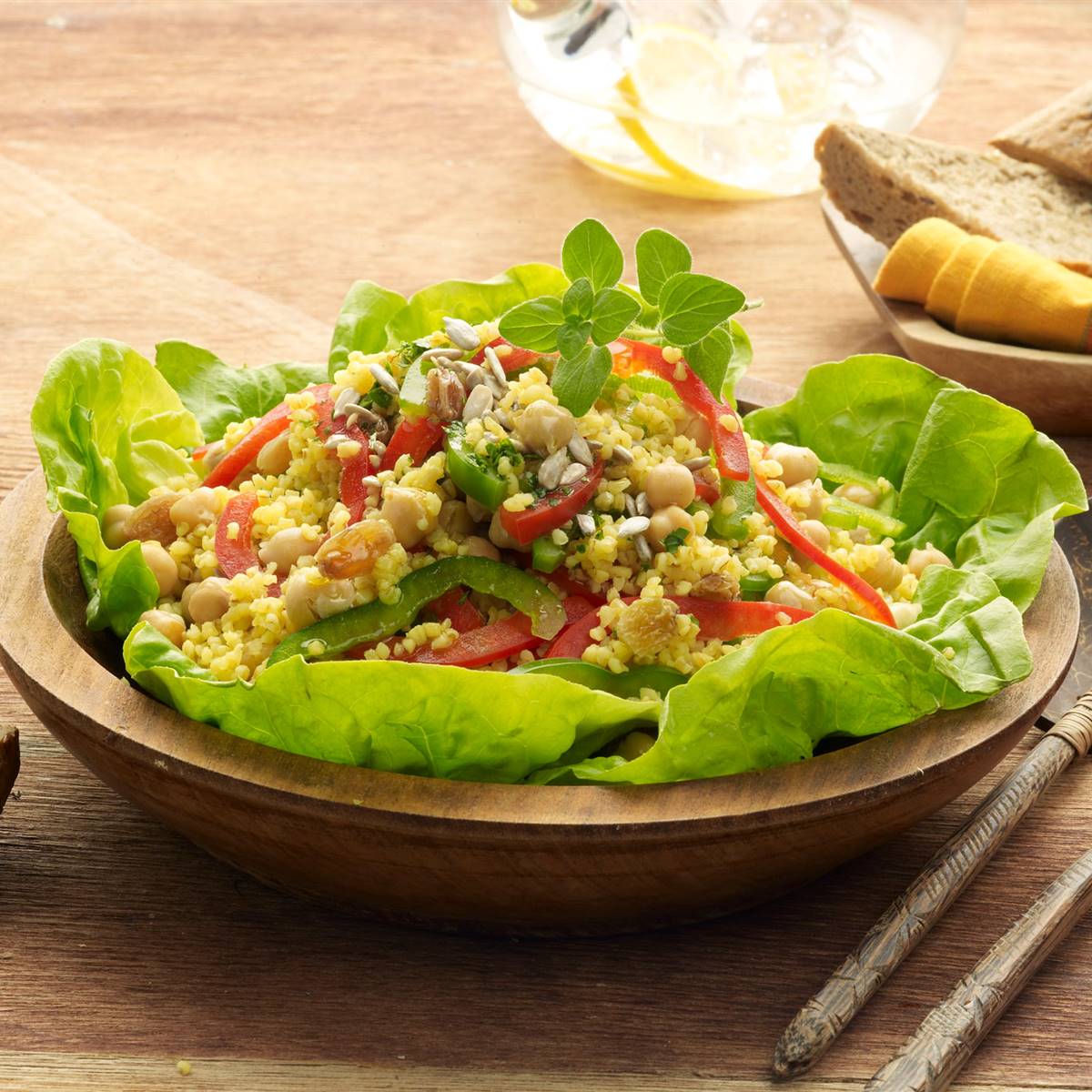
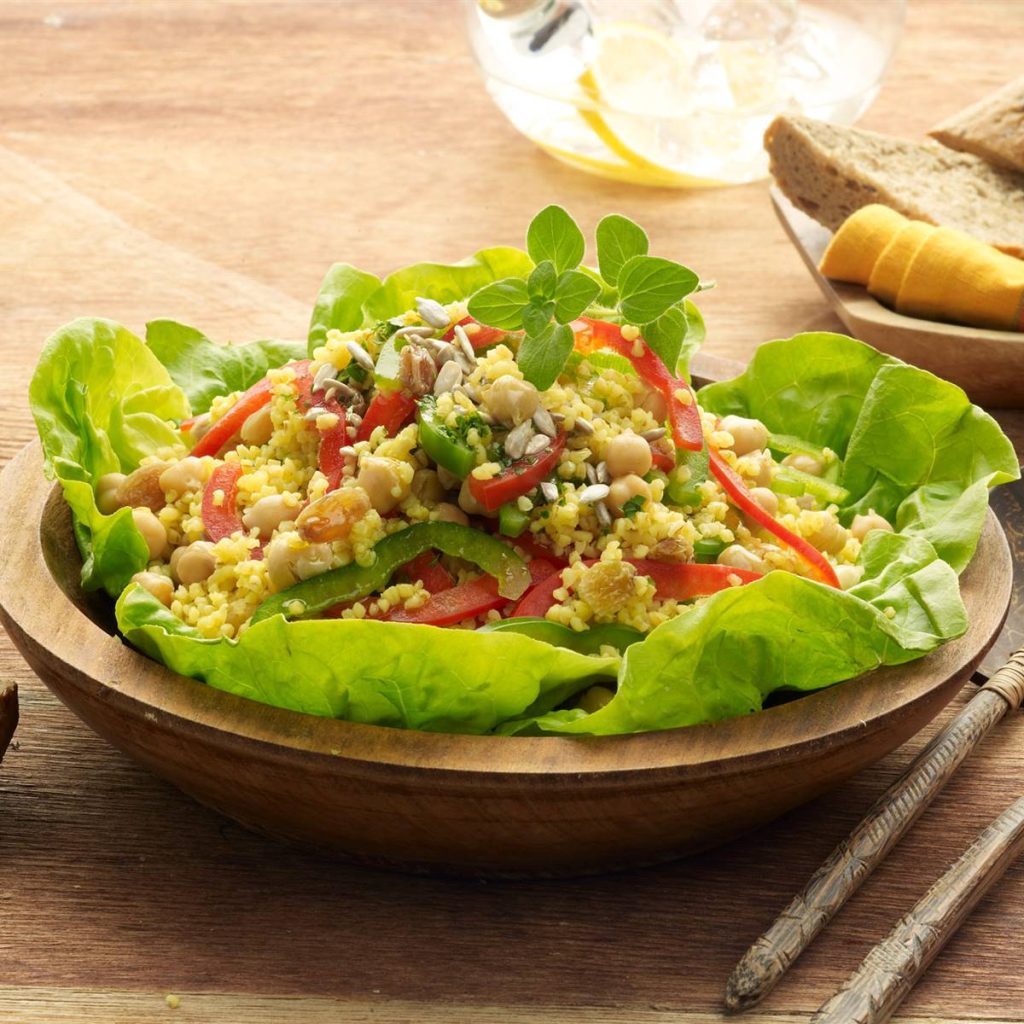
BULGUR SALAD AND TURMERIC PEPPERS WITH SUNFLOWER SEEDS
Ingredients (for 4 people):
- 1 lettuce
- 120 g bulgur (broken wheat)
- 2 tablespoons Corinthian raisins
- 100 g cooked chickpeas
- 1 red bell pepper
- 2 green peppers
- 50 g sunflower seeds
- 2 tablespoons chopped parsley
- half a teaspoon of turmeric
- apple cider vinegar
- extra virgin olive oil
Preparation (12’+40′ soaking):
- Leave the raisins to soak. Place the bulgur in a bowl and cover with water, in which you will have previously dissolved the turmeric. Let stand 40 minutes and drain.
- Wash the peppers, remove the seeds and cut them into thin strips.
- With the help of a fork, or with your fingers themselves, release the grains of the bulgur while adding a little oil and a few drops of vinegar. Next, mix the semolina with the peppers, pereji1, chickpeas and drained raisins.
- On individual plates form a bed of lettuce leaves. On the leaves spread the mixture of bulgur and crown with a few sunflower seeds.
Variant
This recipe can also be made with couscous, which is prepared by adding the same volume of boiling water. To lighten it, the pipes can be replaced by germinated sunflower.
Nutritional information:
- Calories: 303
- Carbohydrates: 40 g
- Protein: 11 g
- Fat: 11 g
- Cholesterol: 0 mg.
TOMATO SALAD AND “MOZZARELLA” WITH TRUMPETS OF DEATH
Ingredients (for 4 people):
- 15 g dry death trumpets
- 500 g pear tomatoes
- 250 g vegan mozzarella cheese (stick)
- 100 g arugula
- 1 garlic clove
- 2 slices wholemeal bread
- extra virgin olive oil
For the sauce:
- 2 tablespoons virgin olive oil
- 2 tablespoons raspberry vinegar
- 1 tablespoon chopped parsley
- salt
Preparation (15′ + 5′ cooking + 30′ soaking):
- Soak the mushrooms for half an hour to rehydrate and, after that time, drain. In a skillet, with warm olive oil, sauté the trumpets of death along with a clove of chopped garlic.
- Cut the bread into cubes of one centimeter, and also sauté, shaking the pan frequently, until crispy and golden. Remove from the pan and let drain on kitchen paper.
- With the help of a very sharp knife cut the tomatoes into slices. Drain the mozzarella and cut into slices of the same thickness as the tomatoes.
- In a dish arrange, overlapping, the slices of tomato and mozzarella, forming concentric circles. Spread arugula around and add the trumpets of death along with the crusts.
- Prepare the dressing by beating all the ingredients well and pour into the salad at the time of serving.
ITALIAN PASTA SALAD
Ingredients (for 4 people):
- 250 g ears or pasta ties
- 50 g walnuts
- 350 g cherry tomatoes
- 1 red bell pepper
- 1 red onion
- 12 pitted black olives
- 8 very tender mushrooms from Paris
- juice of half a lemon
- 60 g canons
- Extra virgin olive oil and salt
For the dressing:
- 4 tablespoons virgin olive oil
- 2 tablespoons apple cider vinegar
- 40 g fresh basil
- 2 garlic cloves
- freshly ground black pepper and salt
Preparation (10′ + 12′ cooking + 5′ standby):
- Fill a large casserole with water, add salt and bring to a boil. Add the bows or butterflies and cook over medium heat for ten minutes or until the pasta is cooked but biting. Pour into a drainer, cool under tap water and drain.
- Clean the mushrooms and cut them into thin slices. Drizzle them with lemon juice and macerate for a few minutes.
- Meanwhile, in a pan with a little oil, toast the nuts over medium heat and let cool.
- Cut the pepper into strips and the tomatoes in half. Peel the red onion and cut it into very thin strips.
- Prepare the dressing by mixing all the ingredients with the help of a few rods and adding a little water if you want a less thick consistency.
- To present the salad, divide the pasta among four individual bowls. Add the nuts and the rest of the cut vegetables along with the mushrooms macerated in lemon, and then the canons and black olives. Pour the dressing, stir well and serve.
Variants
- This salad is delicious if served warm.
- It can be sprinkled with black sesame seeds or garnished with shavings of Parmesan-type vegetable cheese.
- If preferred or more practical, another paste, such as fusilli, can be used.
Nutritional information
- Calories: 458
- Carbohydrates: 44 g
- Protein: 12 g
- Fat: 26 g
- Cholesterol: 46 mg.
CORN AND BEETROOT SALAD WITH “COTTAGE CHEESE” SAUCE
Ingredients (for 4 people):
- 70 g maize semolina
- 450 ml broth or water
- 400 g cooked beet
- 50 g green lettuce leaves
- Pine nuts for garnish
- 1 tablespoon chopped parsley
- 1 teaspoon salt
For the sauce:
- 125 g vegan cottage cheese (here is the vegan cottage cheese recipe)
- 1 teaspoon olive oil
- 3 teaspoons lemon juice
- 1 teaspoon fresh chives
- 30 g roasted pine nuts
- freshly ground pepper
- salt
Preparation (20′ + 15′ cooking + 2h. rest):
- Prepare the polenta by putting the water to be heated in a high saucepan. When it comes to a boil, salt and add the polenta little by little, while stirring so that it does not form lumps. Cook about ten minutes and, after that time, add the parsley. Pour into a tray smeared in oil to cool and, when it has acquired a solid consistency, cut into a medallion shape with a circular mold.
- When assembling the salads have, on individual plates, a bed with some green leaves; On the lettuce place two medallions of polenta and, on top of each of them, a slice of beetroot. On each one he places a medallion of polenta and another of beets until forming two turrets.
- To prepare the sauce, introduce the cottage cheese, oil and lemon juice in the glass of an electric crusher and beat until you get a cream. Add the chopped chives and freshly ground pepper, and mix. Pour this sauce over the vegetable turrets and serve at the moment garnished with a few pine nuts.
Variants
- This recipe can be made by interspersing the cottage cheese between the polenta and the beetroot and then dressing the turrets with a basil sauce, like a pesto.
- Polenta can be enriched by adding two tablespoons of Parmesan before spreading it on the tray.